
GovCore Customer Success Story
One Board, One Portal, Zero Paper
How the Arizona State Board of Chiropractic Examiners put its regulatory lifecycle online with GovCore — in about five months.
- Type
- Case study
- Client
- Arizona State Board of Chiropractic Examiners
- Published
- August 12, 2026
- Length
- 13 min read
Download this case study
Save the full document or the companion slides.
Executive Summary
The Arizona State Board of Chiropractic Examiners (AZSBCE) protects the public by licensing and regulating more than 2,500 chiropractic physicians — along with chiropractic assistants, extern preceptorship students, and non-physician-owned chiropractic businesses. In 2026 the Board went live on GovCore’s regulatory services portal, completing a journey of roughly five months from project kickoff to go-live.
The scope delivered is the regulatory lifecycle online: four licensure pathways for doctors of chiropractic, guided application and renewal wizards, five online payment flows, a public license-verification and disciplinary-transparency system, online complaint intake, a continuing-education compliance engine, and a published board performance dashboard. Staff process applications in about 70% less time than on the previous system, with roughly 9 fewer manual steps to finalize each file. Renewal processing that once occupied much of the team’s day is now often complete in under an hour, and applications that took weeks to turn around under the Board’s former manual process are processed within hours of receipt. Every day removed from the licensing pipeline is a day sooner a qualified chiropractor can get to work in Arizona.
The shift in one sentence: the public verifies, orders, complains, and inspects without contacting the Board; applicants apply, upload, sign, and pay online; and licensees renew, track continuing education, update their record, and pay without a staff touch — with the Board’s own statutes, fee schedules, deadlines, and publication rules doing the enforcing.
The Regulator: A Focused Board with a Statewide Mandate
The State Board of Chiropractic Examiners is established under A.R.S. § 32-901 as a five-member board — three licensed chiropractors and two consumer members — appointed by the Governor to five-year terms. Its statutory authority spans A.R.S. Title 32, Chapter 8 (§§ 32-900 to 32-934): licensure by examination, reciprocity, endorsement, and universal recognition; specialty certification; continuing education; business-entity registration; and discipline.
The Board’s administrative rules — A.A.C. Title 4, Chapter 7 — set out how applications are processed, including binding licensing time-frames: 25 business days for an administrative completeness review, 120 business days for substantive review, and a 145-business-day overall time-frame for initial licenses.
| Fact | Detail |
|---|---|
| Statutory authority | A.R.S. Title 32, Chapter 8 (§§ 32-900 to 32-934); universal recognition under A.R.S. § 32-4302 |
| Administrative rules | A.A.C. Title 4, Chapter 7 (R4-7-101 et seq.) |
| Board composition | Five members: three licensed chiropractors, two consumer members; Governor-appointed, five-year terms |
| Populations regulated | 2,500+ chiropractic physicians; chiropractic assistants; extern preceptorship students; non-physician-owned business entities |
| Pathways to licensure | Examination, reciprocity, endorsement, and universal recognition |
| Licensing time-frames | 25 business days administrative completeness; 120 substantive review; 145 overall (R4-7-502(K)) |
The Arizona State Board of Chiropractic Examiners at a glance.
from project kickoff to go-live
to process an application
to complete renewal processing
public verification, orders & complaints
The Challenge: A System That Created Work Instead of Removing It
Regulatory boards carry an exacting set of statutory obligations — licensure, discipline, continuing-education compliance, public records, transparency reporting — and every one must be met in full, on time, every time. The Board’s previous system made meeting them far harder than it should have been. Despite a significant investment in the platform, delivering the functionality the Board actually needed required retaining an external IT consultant to build what the vendor did not — and over the life of the engagement, the Board spent roughly as much on outside consulting as it had on the platform itself. Requested improvements moved slowly through repeated cycles of user-acceptance testing and resubmitted documentation, and after more than three years, a Business Entity Portal — a core statutory need — still had not been delivered, leaving the Board exposed on compliance and forgoing key revenue. Routine work, meanwhile, still ran through a person: an applicant emailed a PDF application and a staff member keyed it in by hand; a licensee phoned to ask their renewal deadline; an employer emailed to confirm a license was in good standing; a member of the public wrote in to request a board order.
That model was unsustainable for the Board’s budget, and it had taught the Board a clear lesson: a digital front end over a difficult process is not modernization. The goal had never changed — a modernized technological approach to board infrastructure that reduces costs and overhead while improving services. Achieving it required the statutory logic itself — pathway eligibility, fee schedules, CE thresholds, renewal deadlines, publication rules for disciplinary orders — encoded in software, so routine work would stop reaching a desk at all.
We had invested significantly in our previous platform, but after more than three years we were still waiting on functionality our statutes required. We were effectively paying twice — once for the platform, and again for an outside consultant to build what the vendor didn’t deliver. That model was unsustainable for our budget.
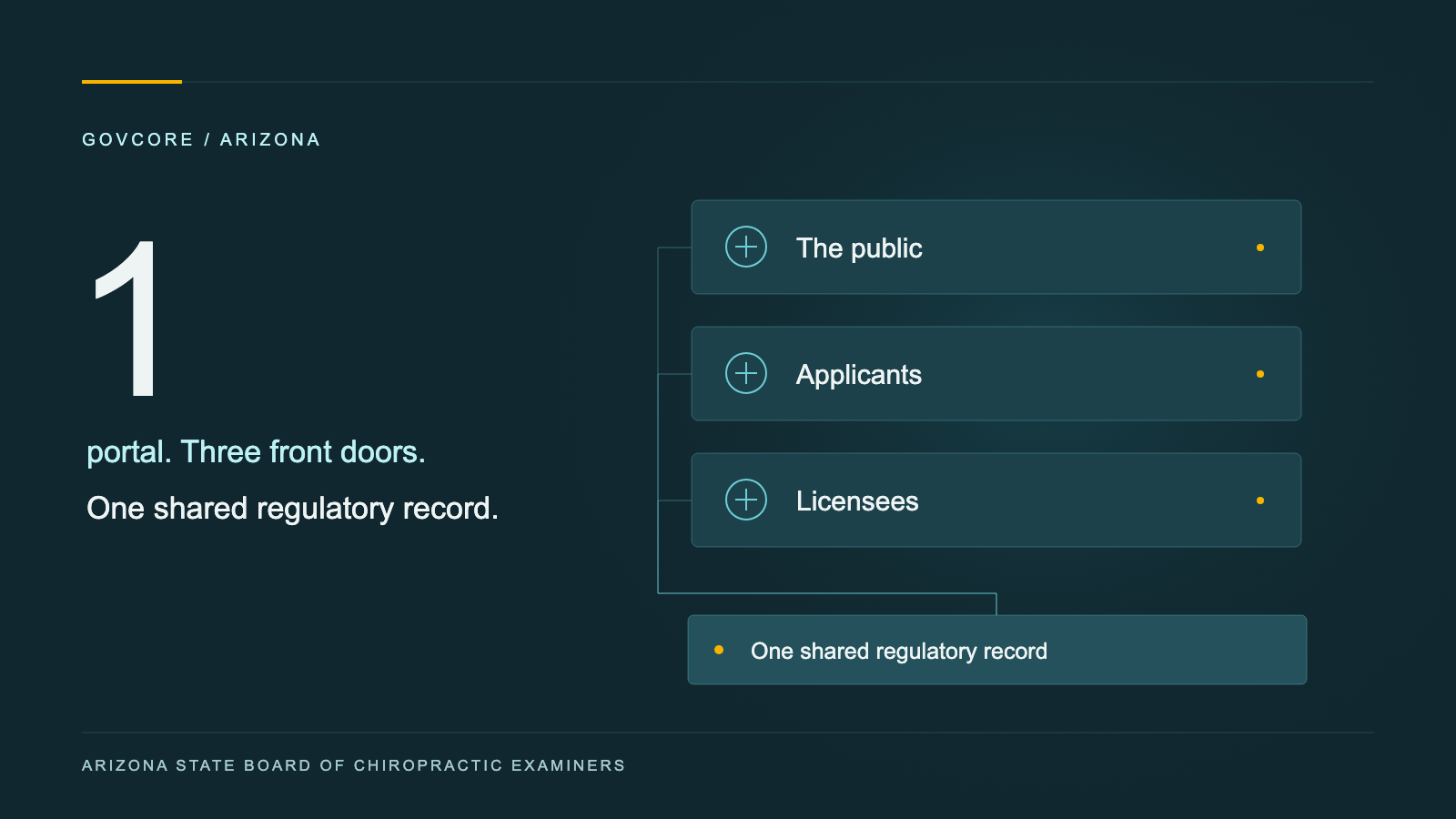
The Solution: One Portal, Three Front Doors
GovCore delivered a single portal with three distinct front doors — public, applicant, and licensee — over one shared regulatory record, configured to the Board’s own statutes, rules, and fee schedules.
The public
Verify licenses, order certified copies, and file complaints — no account required
Applicants
One guided wizard across every pathway to licensure, with fees calculated automatically
Licensees
Renewals, CE tracking, payments, and records — fully self-service
For the public — self-service transparency, no account required
- Verify any chiropractic license — full-text search by name, license number, profession, location, or status. Each licensee page shows the complete public record: license information and history, specialty certifications and permits (acupuncture, physical medicine modalities), places of practice (subject to the licensee’s own privacy election), education, the photograph on file, and board actions.
- Disciplinary transparency, governed automatically — board orders publish only within their approved publication window; an order whose window closes is removed automatically with no staff action, and a withdrawn order becomes inaccessible immediately — even through a previously shared link. Full order PDFs download directly from the page through secure, expiring links.
- Certified copies, self-service — any member of the public can order an official certified copy of a license straight from the verification page, pay the verification fee online, and receive instant confirmation. Employers, hospitals, insurers, credentialing firms, and sister-state boards complete these requests entirely on their own, at any hour.
- Business license verification — the same search treatment for non-physician-owned chiropractic business entities, with exportable results for bulk consumers.
- File a complaint online — a five-step guided intake with a built-in licensee lookup, so the complainant selects the correct respondent rather than entering a free-form name that staff must later reconcile. Evidence files upload directly.
- Public records requests online — replacing letter and email intake.
- CE course catalog — a public, flexible search across board-approved continuing-education courses by name, provider, or approval code in any format. Licensees can confirm in moments whether a course qualifies, without needing to contact the Board.
- Board Performance Metrics — a published, interactive dashboard covering FY 2020–2025 across licensing, enforcement, finance, and three-year projections: seventeen interactive charts with drill-down, standing as a permanent public page — an accountability resource that would otherwise require weeks of analysis to produce each year.
For applicants — one wizard, shaped to the pathway
The online routes to licensure run through a single guided wizard that assembles itself around the applicant’s pathway. A universal-recognition applicant never sees the examination step; an extern preceptorship student answers preceptor, sponsoring-college, and program-date questions drawn straight from the Board’s own form. When the Board added extern preceptorship registration, it was a configuration change plus one new step — not a new application build.
| Application type | Pathways |
|---|---|
| Doctor of Chiropractic | By examination · by endorsement · by reciprocity · by universal recognition (A.R.S. § 32-4302) |
| Extern Preceptorship | Registration (A.A.C. R4-7-1001) |
| Business Entity | Registration |
The Board’s online application matrix, delivered in one wizard.
- Save and resume without losing work — the application saves after every step. An applicant who closes the browser at step nine returns to step nine; an applicant who signed but did not complete payment returns directly to the payment step. Every in-progress draft presents a clear Resume option.
- Documents captured at the point of need — the applicant uploads photographs, certificates, and supporting files at the step that asks for them. Official transcripts and examination results still arrive by mail, direct from the college or testing board that issues them; staff attach each to the applicant’s record on arrival.
- Fees calculated and coded automatically — the Board’s fee schedule is encoded per pathway, and every line item carries its correct state revenue coding before it reaches the payment gateway. Revenue lands in the right state account automatically — no manual coding, no reconciliation.
For licensees — a real self-service account
- A dashboard that knows where you stand — it renders the card matching the licensee’s actual position: renewal window open, payment required, application returned for correction, submitted for processing, and more. When a renewal is approved, the new expiration date appears without logging out and back in.
- Renewal, fully automated end to end — a fifteen-step guided renewal. Continuing education is verified, not attested: the renewal will not advance unless logged, board-approved hours meet the 12-hour annual requirement, and the block message names the hours required and completed. The late fee is calculated automatically from the licensee’s own birth-month deadline. Expired licensees automatically receive the additional reinstatement attestation the law requires — exactly when it is required, and never when it is not. Prior renewals remain available for review.
- Continuing education managed year-round — licensees log activities as they earn them, attach the board-approved course, and upload the completion certificate. Cycle totals recalculate automatically on every change, and closed cycles lock to preserve the audited record.
- Every routine request, handled online — address management with postal validation and a privacy election controlling what the public sees; CPR/ACLS/PALS certification records; official verification letters to sister-state boards or employers, ordered and paid online; a print-ready wall certificate on demand; outstanding invoices payable individually or all at once with unified receipts; complaints visible and answerable in the portal; and a periodic profile currency check that keeps the register accurate by design. The Board’s FAQ and resource library are content-managed by staff — no code release required.
- Business entities get their own complete track — a ten-step registration application, an eight-step renewal, and online ownership-change, name-change, and address-change flows, each with its own payment path.
Security is designed in, not bolted on: multi-factor authentication on every account; secure, expiring links for certificates, renewal documents, and board orders, with authorization re-checked on every retrieval; and a supervised support view that lets Board staff see exactly what a licensee sees, to help — visibly flagged, and without ever handling a licensee’s password.
A Partnership, Not a Handoff
From kickoff to go-live, the journey took approximately five months. GovCore assigned the Board a dedicated engagement manager — a single point of contact who knows the Board’s regulatory framework — and the two teams met on a regular cadence, during implementation and after. Those meetings are where the Board raises what is working and what is not, and where the next round of improvements is agreed together.
- 01
Kickoff
dedicated engagement manager assigned
- 02
Configuration
statutes, rules, and fee schedules encoded
- 03
Review
Board walkthroughs and refinement
Go-live
entire regulatory lifecycle online
Continuous care
regular check-ins and automatic upgrades
When we raise something with GovCore, it gets addressed. After years of feeling blocked, having a partner that listens and responds has made all the difference for our team.
Early Results: The Automation Dividend
Every item below is work that used to require a staff member and now does not. The early results:
| Measure | Previous system | With GovCore |
|---|---|---|
| Staff time to process an application | About 45 minutes | About 70% less |
| Manual steps to finalize an application | About 12 steps | About 3 steps |
| Average days from submission to completion | About 15 business days | About 1 day |
| Incomplete applications requiring staff follow-up | About 35% of files | About 10% of files |
| Manual process eliminated | What the portal does instead |
|---|---|
| Fielding status inquiries from employers and credentialing firms | Public verification search, 24/7, with photo, history, certifications, and practice locations |
| Mailing certified license copies on request | Self-service ordering with online payment and instant confirmation |
| Fulfilling requests for disciplinary orders | Published orders with automatic publication-window enforcement and secure download links |
| Manually keying emailed PDF applications | Pathway-aware application wizard writing straight to the regulatory record |
| Following up on incomplete applications | Per-step saving, automatic draft detection, and explicit resume |
| Looking up which fee applies | Fee schedule encoded per pathway |
| Coding payments to state accounts | Revenue codes applied to every line item automatically |
| Auditing CE hours at renewal | CE compliance verified against approved courses before renewal can proceed |
| Calculating and invoicing late fees | Birth-month deadline computed per licensee; the penalty applied automatically |
| Manually entering address changes by hand | Self-service address management with postal validation and privacy election |
| Reconciling misidentified complaint respondents | Licensee lookup embedded in the public complaint intake |
| Building the annual performance report | Standing public dashboard: 17 charts across licensing, enforcement, finance, and projections |
The automation dividend — manual processes eliminated by the portal.
The direction is already clear from the Board’s own experience. Renewal processing that once occupied much of the team’s day is now often complete in under an hour. Applications that took weeks to turn around under the former manual process are decided within hours of receipt — and because licensees verify their continuing-education compliance before submitting, applications arrive more complete, compressing processing timeframes further. With licensees now onboarded to the portal, phone volume is declining, and public records requests move faster because every request lands in a single queue for assignment and processing.
Two gains stand out. First, throughput: staff spend roughly 70% less time processing each application, and the manual steps that used to stand between an application and a decision are gone — which is how qualified chiropractors get licensed and get to work in Arizona sooner. Second, compliance: the system enforces statutory deadlines, CE thresholds, late fees, and publication windows on a single audited record. On GovCore, the Board meets every statutory deadline on time — 100%. This makes the Board’s compliance posture stronger, and easier to demonstrate, than it has ever been.
Renewals used to consume our day. Now the process often takes less than an hour. Applications we once turned around in weeks under our paper model, we now process within hours of receiving them.
Beyond Go-Live: Continuous Care
Go-live was a milestone, not a finish line. GovCore continues structured post-launch care: fine-tuning configuration to the Board’s evolving needs, watching how staff and licensees use the portal, and folding feedback into each improvement cycle. The Board’s licensees are part of that loop too — friction reported by chiropractors using the portal flows back through the Board to GovCore, so services grow steadily more responsive to the audience they serve. The near-term roadmap is concrete: an even more robust licensing portal with in-portal messaging and automatic notifications, and a continuing-education provider portal through which CE providers submit course applications directly to the Board — linked to the renewal system for a single, streamlined compliance process.
Platform improvements arrive the same way: GovCore customers are upgraded to new platform releases automatically, at no additional cost — no board is billed again for capabilities the platform already delivers. And because the AZSBCE portal is configured on GovCore’s shared platform, what this Board proved out, the next board inherits — a new board is configured, not rewritten.
The goal has always been a modernized technological approach to board infrastructure — reducing costs and overhead while improving services. With our previous system, we were overwhelmed by endless testing loops and still didn’t have a Business Entity Portal. With GovCore, it was delivered.
About GovCore
GovCore builds regulatory operations software for licensing boards and government agencies across the United States and Canada, unifying licensing, enforcement, and compliance on a single record. Founded by a 22-year veteran of government regulatory technology, GovCore keeps customer data in its country of origin, maps its controls to NIST SP 800-53, and delivers new platform capabilities to customers automatically. Hundreds of thousands of licensees depend on GovCore.
To see the platform against your own licence types, workflows, and reporting requirements, request a demonstration at getgovcore.com. Demonstrations are provided to government agencies at no cost and create no obligation.
Stay updated
Receive our analysis on the day we publish it.
Occasional analysis of regulatory modernization, for the people who administer licensing programmes. You may unsubscribe at any time.