
GovCore Smart Licensing case study
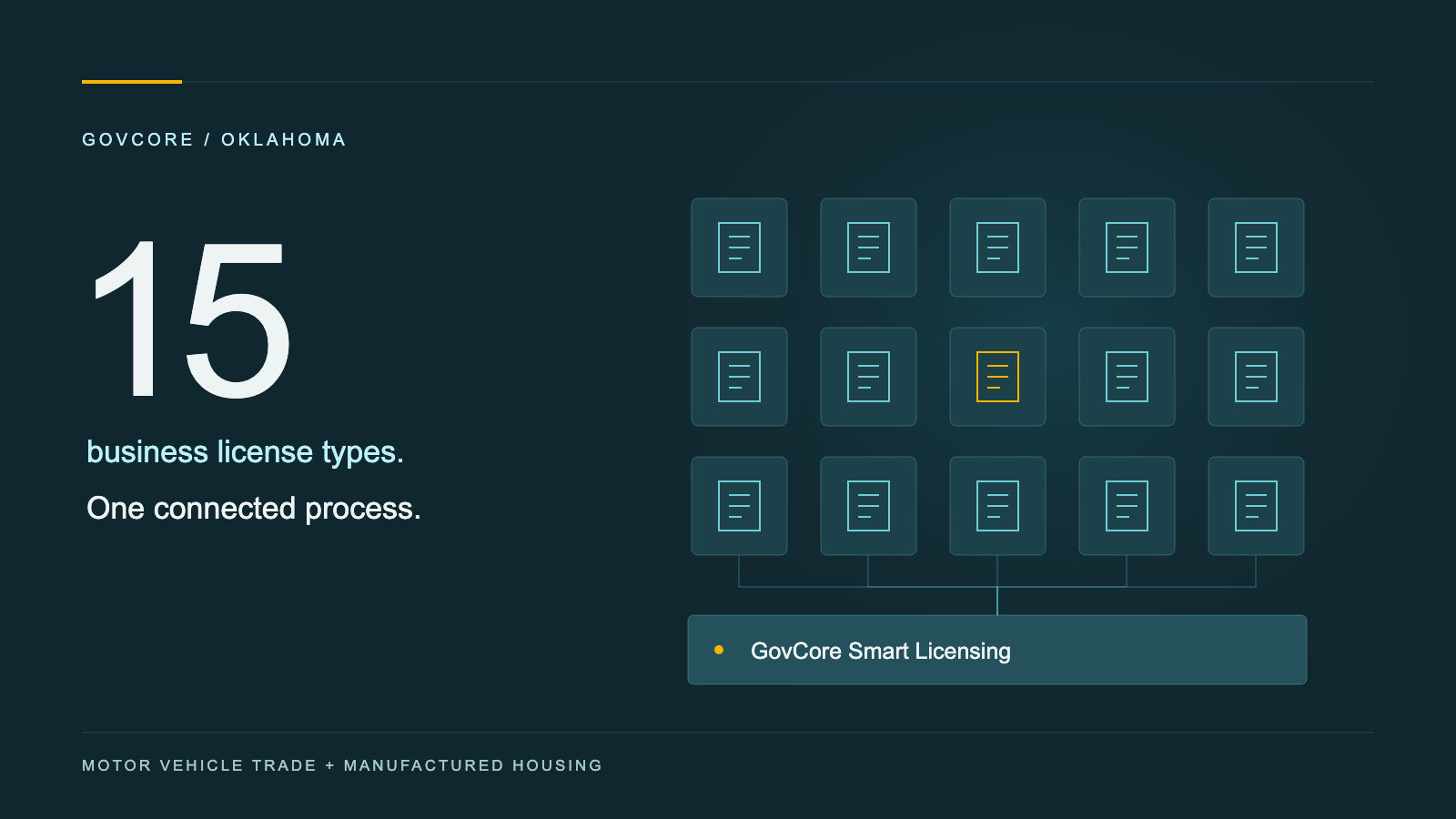
Fifteen license types. One connected process.
Clear requirements for businesses. Connected evidence for staff. Accessible services for the public.
- Type
- Case study
- Client
- Oklahoma Used Motor Vehicle, Dismantler, and Manufactured Housing Commission
- Published
- September 10, 2026
- Length
- 4 min read
Download this case study
Save the full document or the companion slides.
A dealer, a dismantler, and a manufactured home installer have different licensing obligations. The Oklahoma Used Motor Vehicle, Dismantler, and Manufactured Housing Commission oversees fifteen business license types across the motor vehicle trade and manufactured housing. Each type brings its own requirements for people, premises, documents, and fees.
GovCore brings those requirements into one online process. Applicants see the instructions for their license type before they begin. Businesses file changes and reports through self-service. The public can verify licenses and submit complaints. Commission staff receive structured filings with supporting evidence.
| At a glance | |
|---|---|
| Customer | Oklahoma Used Motor Vehicle, Dismantler, and Manufactured Housing Commission (OUMVDMHC) |
| Platform | GovCore Smart Licensing |
| Licensing scope | Fifteen business license types across two industries |
| Service scope | Applications, business updates, industry reports, inspector applications, public services, and payments |
The challenge: different rules, one service experience
Business licensing extends beyond an application. Owners change. Staff join and leave. Businesses move, file bond and insurance updates, and submit industry reports. The Commission needs evidence for each event, while applicants and licensees need to know which requirements apply to them.
GovCore organizes that work around the license type and the transaction. It gives users a clear path through the filing and gives staff the answers and documents needed for review. Regulatory decisions remain with the Commission.
A connected service from application onward
Show the requirements before the work begins
One application process serves all fifteen business license types. It presents the instructions, required forms, and fee for the selected type, then displays the steps that apply. Applicants can save their progress and return to the same filing.
Documents are labeled by their purpose and the person or business information they support. Staff can identify the evidence in context. Applicants have a clear route through the requirements without navigating forms for unrelated license types.
Help businesses handle ongoing obligations
A representative can access the businesses they serve through one account. Businesses can submit location, name, and ownership changes, file bond and insurance updates, and manage authorized representatives. Salesperson and cardholder registrations support batch payment and printable cards.
Approved license certificates and principal wallet cards can be printed from the portal. Their QR codes lead to public verification, connecting the printed credential to the Commission's licensing information.
Bring recurring reporting online
Manufactured home installers can file installation reports. Manufacturers can submit monthly shipment reports, with fees calculated from the information entered. A month with no shipments can still be recorded, making the filing explicit.
Installation inspectors can apply online, save their work, and sign electronically. GovCore produces the Commission's application form as a signed PDF and sends it with the supporting documents to the intake mailbox. Staff receive a familiar form for review.
Connect public access and payments
Public services require no account. People can search business and individual licenses, print verification records, file a complaint linked to a selected business, or submit a public records request with a reference number.
Payments use the State of Oklahoma's hosted payment service. Business applications support card and eCheck. Businesses can pay individual invoices or pay multiple invoices in one transaction. Payment confirmation is checked with the processor before a filing is marked paid.
Where the value comes from
The value is in how the work fits together: requirements guide the filing, evidence stays in context, and routine transactions can be completed online.
| Delivered capability | Practical value |
|---|---|
| License-specific instructions and application steps | Applicants see the requirements relevant to their business. |
| Saved applications and labeled documents | Applicants can resume work; staff can identify the supporting evidence. |
| Business changes and personnel registration | Licensees can submit ongoing regulatory work through self-service. |
| Installation and shipment reports | Reporting and fee calculations are part of the online filing. |
| Public verification and guided intake | People can check licenses and begin a complaint or records request themselves. |
| State-hosted payments and invoice settlement | Payments remain connected to the filing or invoice they cover. |
Applicants see the full requirements before they begin, and what reaches our staff arrives structured, labeled, and ready to review.
A practical model for business regulation
GovCore connects applications, business changes, reporting, public access, and payments. The process reflects the requirements of different license types while giving Commission staff structured information to review.
Clear requirements for businesses. Connected evidence for staff. Accessible services for the public.
Stay updated
Receive our analysis on the day we publish it.
Occasional analysis of regulatory modernization, for the people who administer licensing programmes. You may unsubscribe at any time.